

Plenty of solid businesses are run by owners whose credit reports tell an older story. A medical bill sent to collections during a family emergency. A high card balance from the year the company bought its first truck. A personal score dented by a divorce or a partner who walked away. The business itself may have years of steady deposits, loyal customers, and healthy margins, yet the owner assumes that one number closes every door.
That assumption is often wrong, and it costs owners time and money. This article separates common myths from how funding actually works for established companies, using Fundivi, a nationwide fintech lender based in Brooklyn, New York, as the main example. Fictional businesses and figures are illustrative, and every result depends on underwriting.
What “Imperfect Credit” Usually Looks Like
For an established company, imperfect credit rarely means a failing business. More often, it falls into one of these patterns:
• Old personal setbacks: late payments or collections tied to events outside the business.
• High utilization: personal cards used to fund the company in its early years.
• Thin business file: a company that has paid suppliers in cash and never built a business credit history.
• A past restructuring: a difficult year that the business survived and recovered from.
Each of these says little about how the business performs today, which is exactly why the myths below deserve a closer look.
Myth 1: A Low Score Means Automatic Rejection
Myth: If your personal credit score is below a certain number, no reputable lender will look at your application.
Reality: Many traditional lenders do lean heavily on credit scores, but some alternative lenders weigh the business itself more. Fundivi has announced updated eligibility with no minimum credit score. That doesn’t mean everyone qualifies. It means the score is not an automatic cutoff, and the company’s process looks at the whole business.
What to do: Read how a lender evaluates applications before assuming the answer. The Fundivi homepage for imperfect-credit borrowers describes its underwriting approach and its funding products.
Myth 2: Lenders Only Care About Your Past
Myth: Underwriting is mostly about what went wrong years ago.
Reality: Fundivi says its underwriting uses real-time business performance data, including revenue patterns, cash flow, account balances, payment behavior, and operating history. An AI model reviews that data alongside a dedicated human underwriter. For an established company, recent performance is usually its strongest asset, and this approach gives that performance real weight.
What to do: Before applying, look at your last several months of business banking. Consistent deposits and few overdrafts tell a better story than any explanation letter.
Myth 3: Bad Credit Means Putting Up Your House
Myth: Owners with weak credit always have to pledge personal property or sign a personal guarantee.
Reality: Fundivi states that collateral and personal guarantees aren’t required for certain products, such as working capital. For an owner rebuilding personal credit, keeping a home or savings out of a business deal is a meaningful protection. Secured products, including asset-based loans and equipment financing, draw on business assets by design, and SBA loans carry their own requirements, so read every offer’s terms.
What to do: Ask which product fits your need. The Fundivi loans beyond the credit score page lists working capital, revenue-based financing, lines of credit, term loans, bridge capital, factoring receivables, asset-based loans, SBA loans, and other products, with most amounts running from $10,000 to $5 million and asset-based loans going higher.
Myth 4: Applying Will Make Your Credit Worse
Myth: Every application triggers a wave of inquiries that drags your score down further.
Reality: That happens most often when an application goes to a broker who shops it to many funders. Fundivi says it underwrites an application itself and either funds it directly or routes it to a vetted lending partner, rather than shopping it to many funders. It also says its core working capital products aren’t reported to personal or business credit bureaus, and that pre-qualifying uses a soft inquiry only.
What to do: Ask any lender directly whether it is a direct lender or a broker, and whether it reports to bureaus.
Myth 5: Fast Funding for Weak Credit Is Always a Trap
Myth: If a lender is quick and flexible on credit, it must be hiding expensive terms.
Reality: Some fast funders do hide costs, which is why transparency matters more than speed. Fundivi says its written offers itemize the total cost, repayment structure, fees, and terms before signing.
What to do: Compare offers on total dollars repaid, not just the payment amount, and ask for the effective APR, since factor-rate pricing can make short-term funding look cheaper than it is. A lending platforms feature on World of Business Finance profiles Fundivi alongside other lenders and can show how different platforms describe themselves.
Myth 6: You Need a Stack of Paperwork to Overcome a Low Score
Myth: The only way past weak credit is years of tax returns and audited financial statements.
Reality: Fundivi says tax returns and financial statements aren’t required for most of its products, which typically start with recent business bank statements. Some products, such as term loans and SBA loans, ask for more. Its application takes minutes, according to the company, and decisions can arrive within minutes to hours. Same-business-day disbursement after accepting an offer is possible for qualified applicants, subject to bank verification.
What to do: Have business bank access ready. The faster the data is connected, the faster an underwriter can review it. The merchant portal then shows each step, from application received to funding initiated.
Myth 7: One Bad Season Ruins Your Chances
Myth: A slow quarter on top of imperfect credit makes funding impossible.
Reality: Seasonal businesses are not unusual, and Fundivi says it structures repayment around cash flow, with flexible schedules for seasonal revenue. Underwriters reviewing a full year of deposits can see a predictable seasonal pattern for what it is.
What to do: Be ready to explain your seasonality in a sentence or two. A human underwriter can use that context.
A Fictional Example
Consider a fictional family-owned auto repair shop, fourteen years in business, with about $85,000 in monthly revenue. The owner’s personal score fell after a medical emergency two years ago. The shop needs $40,000 to replace a failing vehicle lift and add a diagnostic system.
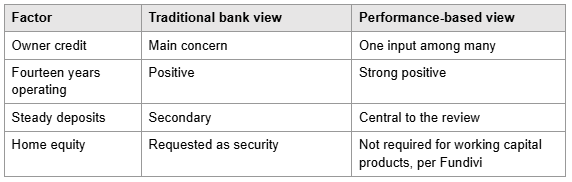
In this illustration, a working capital or term loan structure could fit the need, and the owner would see the full cost before deciding. Whether the shop qualifies, and on what terms, depends on underwriting.
Preparing to Apply
A little preparation helps any owner with a complicated credit history present the business clearly:
1. Connect the primary business bank account, since recent deposits carry the most weight.
2. Note any unusual months and the reason behind them.
3. Decide how much you actually need and what it will pay for.
4. Gather any competing offers so you can compare total cost side by side.
How Fundivi Appears on Lender Comparison Sites
Outside ratings can help when you are uncertain about your options, though comparison sites often receive compensation from the lenders they list. Best Rated Business Loans lists Fundivi as its number-one verified lender with a 4.9 rating, as shown on the Best Rated Business Loans lender comparison page. Business Loans IQ names Fundivi an Editor’s Pick at 4.8 out of 5, and Compare Small Business Loans ranks it number one. Check how each site is compensated before treating a ranking as decisive.
For an established business held back more by an old credit story than by current performance, Fundivi’s no-minimum-score eligibility and performance-based underwriting make it one option to consider. Pricing varies by product, so review the full cost of each offer before deciding.
Frequently Asked Questions
Does Fundivi have a minimum credit score?
Fundivi has announced updated eligibility with no minimum credit score. Approval still depends on underwriting.
Will Fundivi check my personal credit?
Fundivi says credit is one factor among several, weighed alongside cash flow and time in business. Ask about credit review during the application for your specific product.
Is a personal guarantee required?
Fundivi states that personal guarantees and collateral aren’t required for certain products, such as working capital. Secured products and SBA loans carry their own requirements, so confirm the terms of the specific product.
Can I get funded the same day with imperfect credit?
Same-business-day disbursement after offer acceptance is possible for qualified applicants, subject to bank verification.
Will a Fundivi working capital product appear on my credit report?
Fundivi says its core working capital products aren’t reported to personal or business credit bureaus.
What if my business is seasonal?
Fundivi says repayment is structured around cash flow, with flexible schedules for seasonal revenue.
Disclaimer: This article is for general informational purposes only and does not constitute financial, lending, or legal advice. Funding eligibility, rates, terms, and repayment requirements vary by lender, product, and applicant. Readers should review all financing terms carefully and consult a qualified financial professional before making borrowing decisions.