

E-commerce businesses present lenders with a unique picture. There may be no storefront, few physical assets, and sometimes only a couple of years of history. Yet many online sellers generate substantial, well-documented revenue through marketplaces, their own websites, and social channels.
Because of this, lenders who work with online businesses tend to focus heavily on data. Payment processor reports, marketplace dashboards, advertising accounts, and bank deposits tell a detailed story about the health of the business. Understanding which numbers matter, and how to improve them, can make the difference between a strong offer and a disappointing one.
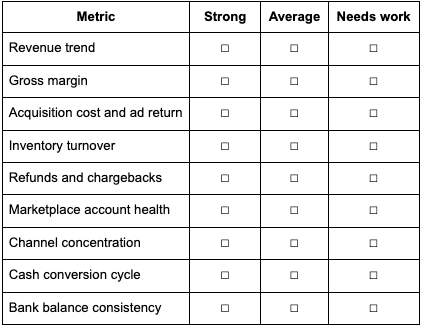
Below are nine metrics that commonly shape funding decisions for online sellers, presented as a scorecard you can use to evaluate your own business.
Metric 1: Monthly Revenue and Its Trend
What it is: Total sales across all channels each month.
Why lenders care: Revenue sets the ceiling on how much financing a business can support. The trend matters as much as the level. Twelve months of steady growth is more reassuring than a single spectacular month followed by a decline.
How to strengthen it: Diversify sales channels so that a single marketplace change does not cut revenue sharply. Track month-over-month and year-over-year growth so you can explain your trajectory clearly.
Metric 2: Gross Margin
What it is: Revenue minus the cost of goods sold, expressed as a percentage.
Why lenders care: Margin shows how much of each sale is available to cover advertising, fulfillment, overhead, and debt payments. Thin margins leave little room for financing costs.
How to strengthen it: Negotiate better supplier pricing, adjust product mix toward higher-margin items, and review shipping and packaging costs regularly.
Metric 3: Customer Acquisition Cost and Return on Ad Spend
What it is: How much you spend to gain a new customer, and how much revenue each advertising dollar produces.
Why lenders care: Many online sellers borrow specifically to fund advertising. Lenders want evidence that additional ad spend reliably generates profitable sales.
How to strengthen it: Track performance by channel and campaign, cut underperforming ads quickly, and document results over time so you can show what a dollar of marketing actually returns.
For example, if a seller spends $10,000 on ads in a month and those ads produce $40,000 in attributable sales, the return on ad spend is 4 to 1. If the gross margin is 50 percent, that $10,000 generated about $20,000 in gross profit, a strong case for funding more of the same.
Metric 4: Inventory Turnover
What it is: How many times inventory sells through in a given period.
Why lenders care: Slow-moving inventory ties up cash and may signal weak demand or poor purchasing decisions. Fast turnover shows that stock converts to cash efficiently.
How to strengthen it: Use sales data to forecast demand, discount or bundle slow movers, and avoid overbuying ahead of uncertain seasons.
Metric 5: Refund and Chargeback Rates
What it is: The share of orders refunded, returned, or disputed through payment processors.
Why lenders care: High rates suggest product quality issues, fulfillment problems, or fraud exposure, all of which threaten future revenue. Elevated chargebacks can even put payment processing accounts at risk.
How to strengthen it: Improve product descriptions and photos, respond to customer service issues quickly, and use fraud screening tools.
Metric 6: Marketplace Account Health
What it is: Performance scores and standing on platforms where you sell, including late shipment rates, order defect rates, and policy compliance.
Why lenders care: A suspended marketplace account can wipe out revenue overnight. Strong account health signals stability.
How to strengthen it: Monitor dashboards weekly, resolve warnings immediately, and maintain reliable fulfillment practices.
Metric 7: Channel Concentration
What it is: The percentage of revenue coming from your largest single sales channel.
Why lenders care: A business earning nearly all of its revenue from one marketplace depends heavily on that platform’s rules, fees, and algorithms. Diversification reduces risk.
How to strengthen it: Develop your own website, email list, and additional marketplaces over time.
Metric 8: Cash Conversion Cycle
What it is: The time between paying for inventory and receiving cash from customers. Marketplace payout schedules, supplier terms, and shipping times all affect it.
Why lenders care: A long cycle means the business needs more working capital to grow. Lenders use this to judge how much funding is truly needed and how quickly it can be repaid.
How to strengthen it: Negotiate longer supplier terms, choose faster payout options where available, and keep inventory lean.
Consider a seller who pays an overseas supplier 60 days before goods arrive, holds inventory for 45 days, and waits 14 days for marketplace payouts. That is roughly four months between spending a dollar and getting it back, which explains why fast-growing online stores so often feel short of cash.
Metric 9: Average Daily Bank Balance and Deposit Consistency
What it is: How much cash your business typically holds and how regularly deposits arrive.
Why lenders care: Consistent deposits and healthy balances suggest the business can handle regular payments. Frequent low or negative balances raise concerns.
How to strengthen it: Avoid sweeping all profits out of the business account, maintain a cushion, and keep business and personal accounts strictly separate.
Scoring Yourself
Rate each metric as strong, average, or needs work. If most fall in the strong column, you are likely positioned for competitive financing. If several need work, consider improving them for a few months before applying, unless the need is urgent.
Financing Options Commonly Used by Online Sellers
Inventory financing helps sellers stock up before peak seasons, often secured by the goods themselves.
Revenue-based financing ties repayment to monthly sales, which can suit businesses with fluctuating revenue.
Lines of credit provide flexible access for recurring needs such as reorders and ad campaigns.
Short-term working capital loans fund defined pushes, such as launching a new product line.
Merchant cash advances are sometimes offered to sellers with heavy card volume. They are fast but often expensive, so resources such as Best MCA Loans are worth reading to understand factor rates and holdback terms first.
Marketplace or platform financing may be offered directly by the services you sell through. These can be convenient, but compare their total cost with independent options.
To see how these products line up, comparison tools like Compare Small Business Loans can help. For urgent situations, such as a supplier requiring payment before a large holiday shipment, Same Day Business Loans Online explains how expedited funding works. Merchant Guidance offers perspective on how financing choices affect daily cash management for card-driven businesses.
Preparing Your Data Package
Before applying, gather the reports lenders most often request from online sellers:
- Twelve months of sales reports from each marketplace and your own website
- Payment processor statements
- Business bank statements for the last six to twelve months
- Advertising account summaries showing spend and results
- Inventory reports and supplier invoices
- A profit and loss statement and balance sheet
- Your most recent business tax return
Make sure the numbers reconcile. If marketplace reports show $90,000 in monthly sales but bank deposits show $70,000, be ready to explain fees, reserves, and payout timing.
Research, Then Apply to the Best Fit
Online sellers are frequently bombarded with funding offers through email, marketplace messages, and social ads. That makes it tempting to click several and apply everywhere. In practice, this approach can backfire. Many providers request direct access to your sales platforms and bank accounts, so applying widely means sharing sensitive data with numerous companies. Multiple applications can also trigger hard credit inquiries on the owner, lowering credit scores, and some lenders may view a burst of recent applications as a warning sign.
A better approach: use your scorecard to understand your strengths and weaknesses, research which lenders specialize in e-commerce businesses like yours, and select the single provider whose product, pricing, and requirements best match your situation. Apply there with complete, accurate data. If the result is not what you hoped for, learn from it, improve the weaker metrics, and approach your next option with a stronger profile.
Making Informed Financing Decisions
For online businesses, the numbers really do tell the story. Lenders read your sales data, margins, advertising results, and account health to judge whether financing will fuel growth or simply add risk. By tracking these nine metrics, strengthening the weak spots, researching carefully, and applying with one well-matched provider, you can secure funding that helps your store scale with confidence, rather than funding that quietly eats into the margins you worked so hard to build.
Disclaimer: This article is intended for general informational and educational purposes only and does not constitute professional, financial, legal, or other advice. The information provided may not apply to every situation, and results may vary depending on individual circumstances. Readers are encouraged to conduct their own research and consult a qualified professional before making any decisions based on the information presented.