
Somewhere in Nigeria tonight, a teenager with a headache will reach for whatever is closest: a leftover tramadol tablet from a parent’s back pain prescription, a swallow of codeine-laced cough syrup, maybe both, one after the other, because the first didn’t seem to work fast enough. Nothing dramatic will happen. No ambulance, no emergency room, no obvious sign that anything unusual occurred at all. And that is exactly why this combination deserves far more attention than it gets.
Tramadol and codeine are two of the most familiar analgesics in the world, sold across pharmacy counters in Nigeria and internationally, prescribed for everything from dental pain to post-surgical recovery, individually judged by regulators to carry a manageable risk profile when used as directed. But a growing body of research, including a study I co-authored with colleagues at the University of Lagos and published in the journal Neurotoxicity Research, shows that what happens when these two drugs are combined, particularly in the kind of repeated, escalating pattern known as “stacking” or “boosting”, is not simply the sum of two mild risks. It is something else entirely.
What the Research Actually Found
Our study set out to replicate, under controlled laboratory conditions, a pattern of use that had been observed anecdotally but rarely studied directly: adolescents combining and escalating doses of tramadol and codeine over consecutive days, rather than taking either drug once at a standard dose. Ninety-six adolescent mice were divided into groups and treated three times daily for nine days with either a vehicle control, tramadol alone, codeine alone, or the two combined, across a range of increasing doses.
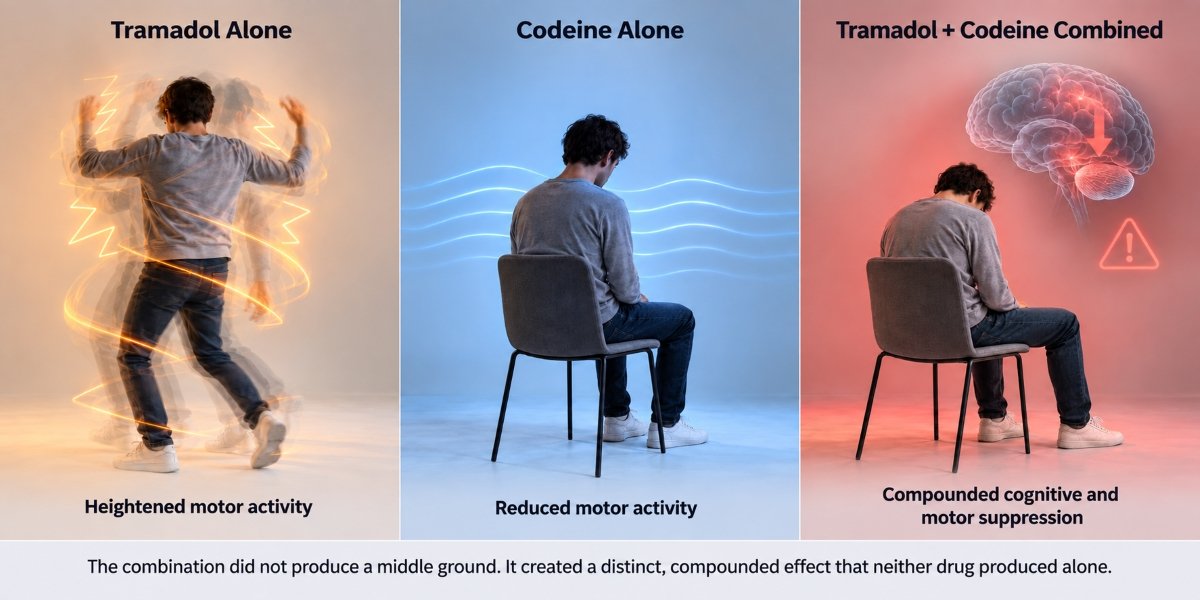
The behavioral results alone were striking. Tramadol on its own produced hyperactivity and repetitive, stereotypic movement patterns. Codeine on its own produced the opposite, reduced activity, alongside what researchers describe as a mild nootropic, or memory-supporting, effect. But the combination of the two did not land somewhere in between these two individual profiles, the way a simple average might predict. Instead, the tramadol–codeine combination produced a marked reduction in both spontaneous motor activity and cognitive function, a distinct, compounded effect that neither drug produced when given alone.

Underneath that behavioral change, at the cellular level, the picture was equally clear. Across the prefrontal cortex and midbrain, brain regions central to decision-making, movement control, and cognition, tramadol, codeine, and their combination all triggered a marked increase in nitroso-oxidative stress, alongside inhibition of mitochondrial complex I activity, a key step in how brain cells generate usable energy. Gene expression analysis using real-time PCR further showed measurable upregulation of genes associated with neurotoxicity. Taken together, the findings pointed to a clear mechanism: repeated, stacked exposure to this drug combination was placing a compounding chemical burden on the developing adolescent brain, well beyond what either drug’s individual safety profile would suggest.
Why the Adolescent Brain Is a Special Concern
Adolescence is not simply a smaller version of adulthood, biologically speaking. It is a period of active, ongoing brain development, synaptic pruning, myelination, and prefrontal cortex maturation are all still underway, often continuing into the mid-twenties. A nervous system in that state of active construction is more vulnerable to disruption than a fully matured one, and the kind of mitochondrial strain and oxidative stress our research documented is exactly the sort of disruption that a developing brain is least equipped to absorb without lasting consequence.
This is part of why the pattern of misuse we studied, stacking and boosting doses of tramadol and codeine, is a particular public health concern in adolescent and young adult populations across Nigeria and West Africa, where both substances remain widely accessible and where the practice of combining or escalating doses “for effect” has been documented as a recognized pattern of recreational misuse, not merely an occasional accident.

What This Means at the Pharmacy Counter and at Home
None of this requires an intentional overdose to matter. It requires repetition, and it requires combination, the quiet, everyday scenario of two ordinary medicines meeting each other in the same bloodstream, on more than one occasion, without anyone flagging the risk.
For pharmacists and pharmacy assistants, this points toward a specific, practical counseling opportunity: any patient picking up either tramadol or codeine is worth a brief, direct question about what else is currently in their medicine cabinet, particularly in households with adolescents. For parents and caregivers, the takeaway is less about fear and more about visibility, knowing what is in the house, understanding that “leftover” medication is not inherently safer just because it was once prescribed, and recognizing that a foggy morning after an ordinary night is worth a conversation, not a shrug.
The invisible arithmetic of drug combinations rarely announces itself. That is precisely why it deserves to be talked about out loud, before the next ordinary Friday night.
Published Research Referenced: Ishola, I., Eneanya, S., Folarin, O., Awogbindin, I., Abosi, A., Olopade, J., & Okubadejo, N. (2022). Tramadol and codeine stacking/boosting dose exposure induced neurotoxic behaviors, oxidative stress, mitochondrial dysfunction, and neurotoxic genes in adolescent mice. Neurotoxicity Research, 40, 1304–1321.