

Melody Lubin brings her background in fitness and the feminine arts to a practice attracting international participants
Before she attended her first Wildgrace experience, she spoke with its owner, Sigourney Belle. Belle asked why she wanted to come, she already felt that teaching for the organization would be part of her future. Eighteen months after that first experience, she had become its head trainer. The conviction preceded the appointment; the experience gave it somewhere to develop.
She arrived with seven years in the fitness industry, years of anatomy studies, and involvement in the healing arts. Those backgrounds brought different ways of understanding the body into the same conversation. What interested her was how physical experience, emotional capacity and spiritual practice might speak to one another, rather than remain separate areas of her working life.
Melody Lubin, a visionary, teacher, and mentor of the feminine arts, now leads a body of work shaped by that question. Her experience includes international teaching for Wildgrace and the development of her own retreats and work with women. In describing the practice, she emphasizes the connection she sees between physical and emotional life.
Wildgrace introduced her to an approach concerned with the nervous system and personal change. It became a significant chapter in her development as a teacher. As head trainer, she travelled internationally to lead trainings for the organization. The work offered an opportunity to move beyond her initial experience and take responsibility for teaching others. Alongside training others who were learning the modality that Wildgrace taught.

That progression is a concrete part of a story that can otherwise sound abstract. Lubin speaks in the language of calling and intuition, but her background also includes sustained study, professional experience, and an identifiable teaching role. The conviction she brought to her first conversation did not replace those experiences. It sat alongside them.
Her next step was to develop work under her own name. She describes this as an organic development, prompted by noticing where a purely physical focus left questions unanswered and where energy-based teachings also had limits. She wanted to bring the areas together more closely. The gaps she perceived became part of the reason to build something of her own.
“I knew that what I was bringing was unique,” she says. The statement reflects her sense of direction as a practitioner. What she wanted to explore was the relationship between systems that are often discussed separately, and how that relationship might inform the experiences she created. Her work grew from curiosity about their connection as much as conviction about her next step.
Lubin uses terms including somatic work and nervous-system work to describe her practice. In her account, the body is central to understanding personal experience. Spiritual reflection also has a place, but it does not remove the physical person from the picture. That emphasis connects her earlier attention to anatomy with the broader questions she began asking through her teaching and personal practice.
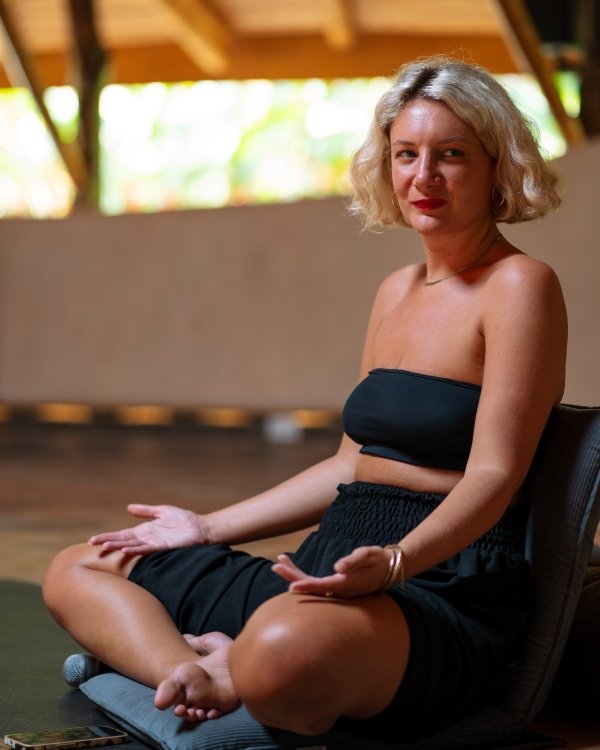
For women considering her work, that background offers a way to understand how she arrived at her current emphasis. Fitness came first as a substantial professional chapter. Anatomy study informed her attention to the body. Her involvement in the healing arts and her Wildgrace experience expanded the questions she wanted to pursue. Her own work brings those influences into one practice.
She is direct about the tone she wants to bring to it. She describes parts of her industry as “fluffy” or “ungrounded” and explains that she values a more direct delivery. The emphasis is on helping people consider their own fullest expression and really transform themselves and their reality, without decorating the conversation so heavily that its purpose becomes difficult to recognize.
That position also gives context to her choice of title. Lubin identifies as a facilitator and mentor of the feminine arts, and more recently as a teacher, leader, and speaker. The titles describe different parts of the work she wants to do. Taken together, they suggest someone concerned both with creating experiences and with communicating the thinking behind them.
Her current body of work has a record of participation of its own. Lubin reports sold-out experiences, with women travelling from around the world to attend and returning after exploring other approaches. She counts that continued interest among her most meaningful achievements. It gives the story a present-day focus beyond her earlier position at Wildgrace: women are seeking out the practice she has developed under her own name, her body of work is renowned within her industry. Building it has also created a life in which she can travel and teach, though she acknowledges the demands of running a business. The success she describes combines that professional independence with sustained relationships with participants.
Speaking is another part of that momentum. She says invitations to speak at summits and within businesses arrive frequently, offering further settings in which to share her message. Looking ahead, she wants to continue accepting opportunities that fit her direction, create more experiences for women, and explore bringing men into the work. These ambitions build on a practice already drawing participants and invitations, while leaving room for her teaching to develop.
For Lubin, the thread connecting these chapters is the wish to bring different parts of a person’s experience into closer conversation. Her next work will continue drawing on the physical and spiritual questions that first led her beyond fitness alone. Readers can learn about her current offerings at www.melodylubin.com and follow her teaching and reflections on Instagram, where her public work offers a starting point for understanding that direction.