By: Jay Kt
Completing a manuscript is a major achievement.
After months or even years of writing, you finally have a complete draft. You read through it again, make changes, adjust sentences, and refine chapters. But after multiple rounds of self-editing, many authors reach a point where every sentence starts to look the same.
This is completely normal.
When you spend months inside the same manuscript, it becomes difficult to see the problems a new reader will notice. Missing transitions, unclear structure, pacing issues, repeated ideas, and inconsistencies can become invisible to the person who created the story.
This is where professional book editing services become essential.
Editing is not just correcting grammar mistakes. It is a structured process that improves your manuscript at different levels, from the overall structure of your book to the final details before printing.
At Author Path Publishers, manuscripts move through the right editing stages to help transform drafts into polished, publication-ready books.
Why Authors Need Professional Editing
Self-editing is an important part of the writing process.
Your own revision can help identify:
- Repeated words and phrases.
- Unnecessary scenes.
- Weak transitions.
- Sections that need more explanation.
However, authors often struggle with the deeper issues because they already know the story they are trying to tell.
You remember the missing details. You understand why a chapter changes direction. You know what happened before and after each scene.
Readers do not have that background.
A professional editor provides the outside perspective needed to understand how your manuscript works for someone experiencing it for the first time.
Editing helps answer important questions:
- Does the opening deliver the right promise?
- Does the structure support the story?
- Are chapters arranged effectively?
- Does the writing maintain the intended tone?
- Will readers stay engaged from beginning to end?
Professional editing is not about changing your voice. It is about making your message clearer and stronger.
The Four Levels of Professional Book Editing
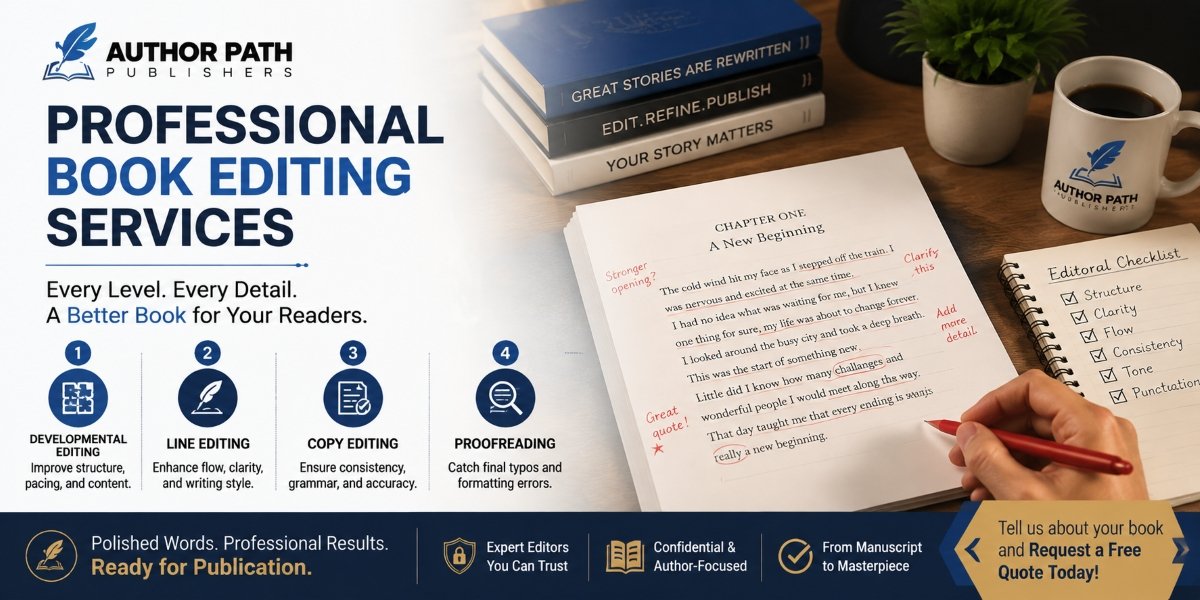
Book editing is not a single step. Different editing stages solve different problems, and they should be completed in the correct order.
1. Developmental Editing: Improving the Structure of Your Book
Developmental editing focuses on the big picture.
Instead of correcting individual sentences, this stage examines the complete manuscript and evaluates:
- Overall structure.
- Chapter organization.
- Story development.
- Pacing.
- Reader engagement.
- Argument or theme development.
A developmental editor asks questions such as:
- Does the book begin at the strongest point?
- Does each chapter serve a purpose?
- Are important ideas introduced at the right time?
- Does the ending deliver what the beginning promised?
For fiction, developmental editing may examine character development, motivations, and plot progression.
For nonfiction, it focuses on clarity, organization, authority, and whether readers can easily follow the ideas.
A lighter option is a manuscript critique, where an editor reviews the complete draft and provides professional feedback without extensive restructuring.
2. Line Editing: Improving the Flow and Voice
After the structure is finalized, line editing focuses on the writing itself.
A line editor reviews the manuscript paragraph by paragraph to improve:
- Sentence flow.
- Word choice.
- Tone.
- Clarity.
- Rhythm.
This stage helps remove sentences that feel repetitive, awkward, or unclear while preserving your personal writing style.
A strong line edit does not make every sentence sound the same. Instead, it helps your existing voice become clearer and more effective.
3. Copy Editing: Correcting Consistency and Accuracy
Copy editing focuses on technical accuracy and consistency.
This stage checks:
- Grammar.
- Spelling.
- Punctuation.
- Capitalization.
- Formatting consistency.
- Number usage.
- Style decisions.
A copy editor may also create a style sheet that records important decisions throughout the manuscript, such as:
- Character name spellings.
- Preferred terminology.
- Formatting choices.
- Specific style rules.
This ensures the entire book follows the same standards from beginning to end.
4. Proofreading: The Final Quality Check
Book proofreading services are the final step before publication.
Proofreading happens after formatting and typesetting because it catches issues introduced during production.
A proofreader looks for:
- Incorrect page breaks.
- Missing words.
- Formatting errors.
- Heading placement issues.
- Typographical mistakes.
Proofreading is not a replacement for editing. It is the final inspection that ensures the finished book looks professional.
Why the Order of Editing Matters
Each editing stage builds on the previous one.
The correct order is:
Step 1: Developmental Editing
Fix the book’s structure and direction before making sentence-level improvements.
Step 2: Line Editing
Improve the writing style once the chapters and organization are finalized.
Step 3: Copy Editing
Correct grammar, spelling, and consistency after the content stops changing.
Step 4: Proofreading
Review the formatted book before publishing.
Many authors request proofreading when their manuscript actually needs structural editing. While the final document may look clean, deeper issues can remain.
Understanding which editing stage your manuscript needs saves time, money, and unnecessary revisions.
What Is Included in an Editorial Review?
A developmental editor often provides an editorial letter explaining:
Book Purpose
Does the manuscript clearly deliver what readers expect?
Structure
Are chapters organized effectively? Are any sections missing or unnecessary?
Pacing
Where does the manuscript slow down, and where may readers lose interest?
Character or Authority Development
For fiction, does the character journey make sense?
For nonfiction, does the author establish credibility and value?
Strengths and Opportunities
What elements are already working, and what changes will create the biggest improvement?
An editorial letter provides a roadmap for strengthening the manuscript.
How Editors Protect Your Writing Voice
Many authors worry that editing will make their book sound different.
A professional editor does not replace your voice.
Your writing style comes from:
- Your word choices.
- Your perspective.
- Your storytelling approach.
- Your unique way of communicating ideas.
A good editor improves clarity while protecting the elements that make your writing personal.
The goal isn’t to rewrite your book in someone else’s style. The goal is to help your message reach readers more effectively.
When Should You Hire a Professional Book Editor?
Your manuscript is ready for editing when:
- The complete draft is finished.
- You have completed your own revisions.
- You understand your book’s purpose and audience.
A professional editor can then provide the guidance needed to prepare the manuscript for publication.
Author Path Publishers provides editing support along with typesetting, formatting, cover design, and publishing assistance to help authors move smoothly from manuscript to finished book.
Frequently Asked Questions
How long does book editing take?
The timeline depends on the manuscript length, condition, and type of editing required.
Developmental editing usually takes longer because the editor reviews the entire manuscript before providing detailed feedback.
What is the difference between line editing and copy editing?
Line editing improves writing style, clarity, tone, and sentence flow.
Copy editing focuses on technical accuracy, including grammar, punctuation, spelling, and consistency.
Do I need a manuscript critique or developmental edit?
A manuscript critique is useful when you want professional feedback and direction before making changes yourself.
A developmental edit provides deeper guidance with detailed notes throughout the manuscript.
Can I skip editing and only get proofreading?
Proofreading is recommended only after the manuscript has been edited and formatted.
A proofreader can correct production errors, but they will not fix structural problems, unclear writing, or weak organization.
Get Your Manuscript Edited by Author Path Publishers
Writing your manuscript was the first major step. Professional editing helps prepare it for readers.
The professional book editing services at Author Path Publishers guide your manuscript through developmental editing, line editing, copy editing, and proofreading to create a polished final book.
You keep full ownership of your work, your manuscript remains confidential, and your project receives expert attention throughout the publishing process.
Whether you need structural guidance, sentence improvement, or final proofreading support, our team helps you understand exactly what your manuscript needs.