

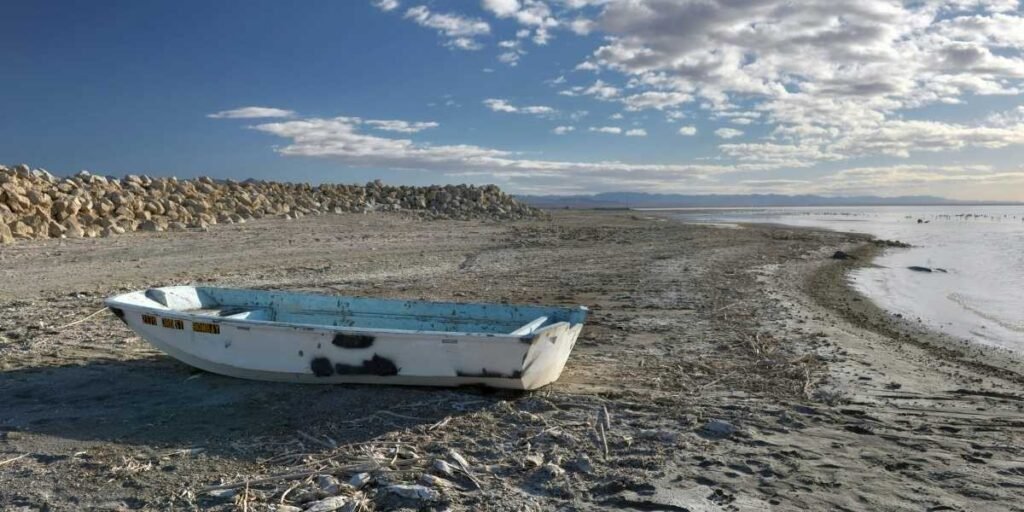
The Salton Sea, California’s largest inland lake, has long been a paradox. Created accidentally in 1905 when the Colorado River breached irrigation canals, it became a recreational paradise in the mid‑20th century, drawing Hollywood stars and weekend crowds to its shores. Today, however, the lake is shrinking at an alarming pace. Over the past three decades, its surface area has receded dramatically, exposing vast stretches of dry lakebed. This exposed playa is not inert sand; it is a toxic mix of agricultural chemicals, heavy metals, and salts that, when carried by desert winds, becomes airborne dust.
Communities in Imperial and Riverside counties are living with the consequences. The shrinking lake is not just an ecological story, it is a human health crisis. Families in towns like Calipatria, Brawley, and Mecca are breathing air laced with fine particles that damage lungs and exacerbate asthma. The Salton Sea has become emblematic of California’s environmental justice challenges, where vulnerable populations bear the brunt of systemic neglect.
Environmental challenges at the Salton Sea
The environmental problems are layered. Agricultural runoff continues to pour into the lake, carrying fertilizers and pesticides that fuel algae blooms. These blooms deplete oxygen, suffocating fish populations and leaving behind foul odors. Recent reports have highlighted that nutrient pollution at the Salton Sea has reached crisis levels, with dangerously low oxygen concentrations recorded across multiple monitoring sites.
Hydrogen sulfide emissions add another dimension of risk. Residents frequently report the rotten‑egg smell that accompanies these emissions, which exceed California’s health standards. While unpleasant, the odor is more than a nuisance; prolonged exposure can cause headaches, nausea, and neurological effects. The reports suggest that air-quality monitoring may underestimate the scale of emissions, leaving communities without accurate data to protect themselves.
The shrinking footprint of the lake also destabilizes ecosystems. Once a critical stopover for migratory birds along the Pacific Flyway, the Salton Sea is losing its ability to sustain wildlife. Fish die‑offs reduce food sources, while receding shorelines eliminate nesting habitats. The ecological unraveling mirrors the human health crisis, creating a feedback loop where environmental degradation directly impacts community well‑being.
Health risks for California communities
More than half a million residents live in the Salton Sea region, many in communities already burdened by poverty and pollution. The health risks are stark. Dust storms originating from the exposed playa carry fine particles that lodge deep in the lungs, aggravating asthma and increasing hospitalizations. Children are particularly vulnerable, with schools reporting higher absenteeism due to respiratory illness.
Hydrogen sulfide emissions compound the problem. While short‑term exposure causes irritation, long‑term exposure raises concerns about neurological damage. Families living near the lake describe headaches, dizziness, and fatigue as part of daily life. These symptoms are not isolated, they reflect systemic exposure to environmental hazards.
The UCLA briefs highlighted that residents in the Salton Sea region rank among the most pollution‑burdened in California. This raises a pressing question: why are some of the state’s most vulnerable communities left to shoulder the consequences of environmental decline? The cultural framing here is unavoidable. The Salton Sea is not just a lake; it is a mirror reflecting inequities in California’s environmental policies.
California’s response: gaps and opportunities
State and local agencies have launched restoration projects, but progress has been slow. Dust suppression projects, wetlands restoration, and water‑management strategies have been proposed, yet implementation lags behind the urgency of the crisis. The Pacific Institute’s 2025 report urged a new approach, emphasizing immediate public‑health protections alongside long‑term ecological restoration.
Oversight gaps remain a critical issue. Monitoring systems often fail to capture the full extent of emissions, leaving residents without reliable information. Without accurate data, communities cannot advocate effectively for protections. This lack of transparency undermines trust and perpetuates feelings of abandonment.
The curiosity gap is whether California can balance ecological restoration with immediate health protections. Will investments in habitat restoration arrive in time to shield residents from worsening air quality? Or will communities continue to suffer while long‑term projects inch forward?
Cultural framing: the Salton Sea as a California story
The Salton Sea is more than an environmental crisis, it is a cultural symbol. Once a playground for Hollywood stars in the 1950s, it now represents the consequences of neglect and the urgency of action. For California, a state that prides itself on innovation and environmental leadership, the Salton Sea is a test of values.
The lake’s decline resonates with broader themes in California’s identity. It reflects tensions between agriculture and conservation, between urban centers and rural communities, between promises of environmental justice and the realities of inequity. The Salton Sea forces Californians to confront uncomfortable questions: who benefits from environmental policies, and who is left behind?
What the Salton Sea means for California in 2025
The Salton Sea’s challenges are not isolated, they connect to broader issues of water scarcity, climate change, and environmental justice. For California, the stakes are high. Protecting residents from toxic emissions is a public‑health imperative. Preventing property devaluation and rising healthcare costs is an economic necessity. Demonstrating leadership in environmental justice is a cultural responsibility.
The bigger picture is clear: the Salton Sea is not just about a shrinking lake. It is about fairness, responsibility, and the future of California’s communities. Whether California rises to the challenge will determine not only the fate of the Salton Sea but also the credibility of its environmental commitments.