By: Julian Marks
California has always had a complicated relationship with nostalgia. This is a state that bulldozes its landmarks, reinvents its neighborhoods, changes its sound every few years, and then spends enormous amounts of money trying to recreate whatever it just discarded. From Laurel Canyon to the Sunset Strip, from Fleetwood Mac harmonies floating through Topanga to Heart blasting out of an FM radio somewhere on the 405, California music has often been obsessed with the tension between moving forward and looking back.
That makes Eleyet McConnell’s “Your Eyes” feel strangely at home here.
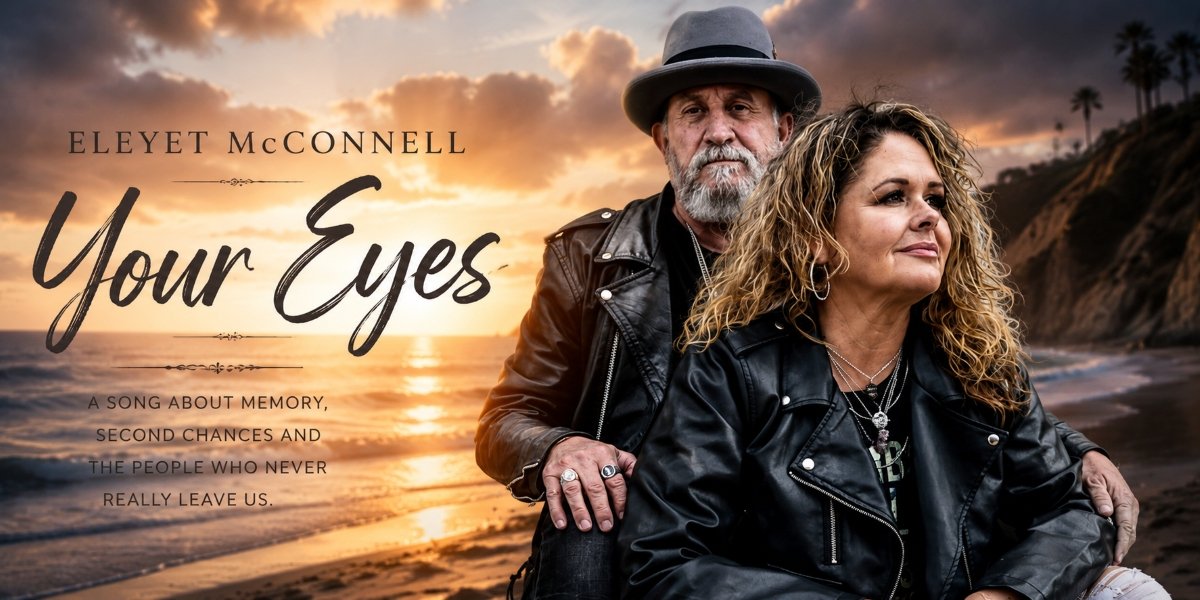
The Ohio husband-and-wife duo may be thousands of miles removed from the Pacific, but their piano-driven ballad from The Journey carries the particular emotional ache of driving west at sunset with too much history in the rearview mirror. It’s a song about remembering someone who occupied an earlier version of your life, and realizing that time doesn’t necessarily erase the people who helped create you.
The story behind it couldn’t be less Hollywood.
Chris McConnell was in Walmart when he spotted an old high-school heartbreak from a distance. He wondered whether, if he approached her, they might simply pick up their conversation where it had ended decades earlier. He didn’t. Instead, he walked out with a song forming in his head.
There’s something perfect about that.
California mythology would put the encounter at Chateau Marmont or some dimly illuminated Laurel Canyon party. Real life puts it under fluorescent retail lighting.
Chris took the idea home to Angie McConnell, his wife, musical partner, and lead singer. Angie added a bridge.
If that doesn’t tell you something about the emotional maturity behind Eleyet McConnell, nothing will.
“Your Eyes” isn’t a song about wanting to exchange the present for the past. It’s about recognizing that some emotional fingerprints never completely disappear. The person you loved at 17 may no longer belong in your life, but the person you became partly exists because they once did.
Musically, the McConnells resist nearly every temptation to overproduce that idea.
Piano leads. Strings supplied by Kimmi Sampson gradually expand the arrangement. Producer Patrick Himes leaves considerable air around everything. There are no unnecessary guitars crashing through the door because somebody decided a rock duo needs to prove it can rock.
That restraint puts Angie exactly where she belongs, dead center.
Her performance recalls an era when California radio made room for singers who could dominate a track without suffocating it. There’s the emotional authority associated with Linda Ronstadt, the muscular vulnerability of Pat Benatar, a little of Stevie Nicks’ ability to make memory feel supernatural, and some of the dramatic pop instinct that made Patty Smyth such an effective bridge between rock toughness and romantic exposure.
But Angie McConnell isn’t performing an Eighties tribute.
Her voice has too much mileage for that.
You hear experience in the grain, the sense that these aren’t emotions she studied for the recording session. Her greatest decision is refusing to oversing them. “Your Eyes” could easily become one of those ballads where every verse exists merely to provide transportation to The Big Note. Angie understands that the quieter passages are the reason the bigger moments matter.
It’s the difference between singing loudly and singing powerfully.
California should understand the distinction.
Some of the state’s most enduring records were built around atmosphere rather than force. Think about what happened when Linda Ronstadt allowed a melody to breathe, when Jackson Browne made introspection sound cinematic, or when Fleetwood Mac transformed complicated personal histories into pristine pop.
“Your Eyes” belongs somewhere downstream from that tradition.
The strings deserve particular credit. Rather than coating the song in sentiment, Samson uses them to deepen its emotional temperature. They feel almost like the Pacific marine layer rolling inland at dusk, present and atmospheric, gradually changing everything without demanding that you watch it happen.
And beneath the arrangement lies something even more unusual for contemporary pop music: adulthood.
Rock and pop remain infatuated with youth. We’re endlessly hearing about the night somebody met somebody, slept with somebody, left somebody, texted somebody, blocked somebody, or decided at 2 a.m. that somebody was the only human being who had ever understood them.
Eleyet McConnell are writing from the other side of all that.
“Your Eyes” recognizes friendship as part of romance. It acknowledges aging. It understands that memory changes shape over time and that lasting love isn’t sustained by remaining perpetually young. It’s sustained by continuing to recognize each other as the people underneath everything life piles on top.
That perspective gives the song weight.
It also makes the circumstances of its creation unexpectedly moving. An old girlfriend inspires Chris to think about the past. His wife helps him finish the thought.
Past and present don’t compete.
They coexist.
Drive north on the Pacific Coast Highway late enough in the afternoon and the view occasionally performs a similar trick. The road keeps moving forward while the mirror fills with something beautiful disappearing behind you. You can’t go back to it, and you’re not supposed to.
But you can look.
You can remember.
Then you keep driving.
That’s “Your Eyes.”
Eleyet McConnell haven’t reinvented the power ballad. They’ve done something more difficult: they’ve remembered why anyone cared about one in the first place.
And somewhere between Ohio and the California coast, memory still sounds pretty good with a piano underneath it.