By: Travis McCall
California has always been a destination for people who believe the next horizon might change everything.
Musicians are particularly susceptible to the idea. For generations, they have packed guitars into cars and pointed west, following a dream through Bakersfield, San Francisco, Laurel Canyon, Hollywood and a thousand roadside bars in between. Some found record contracts. Most found something considerably less glamorous: another gig.
That second group is the one Noble Hops understands.
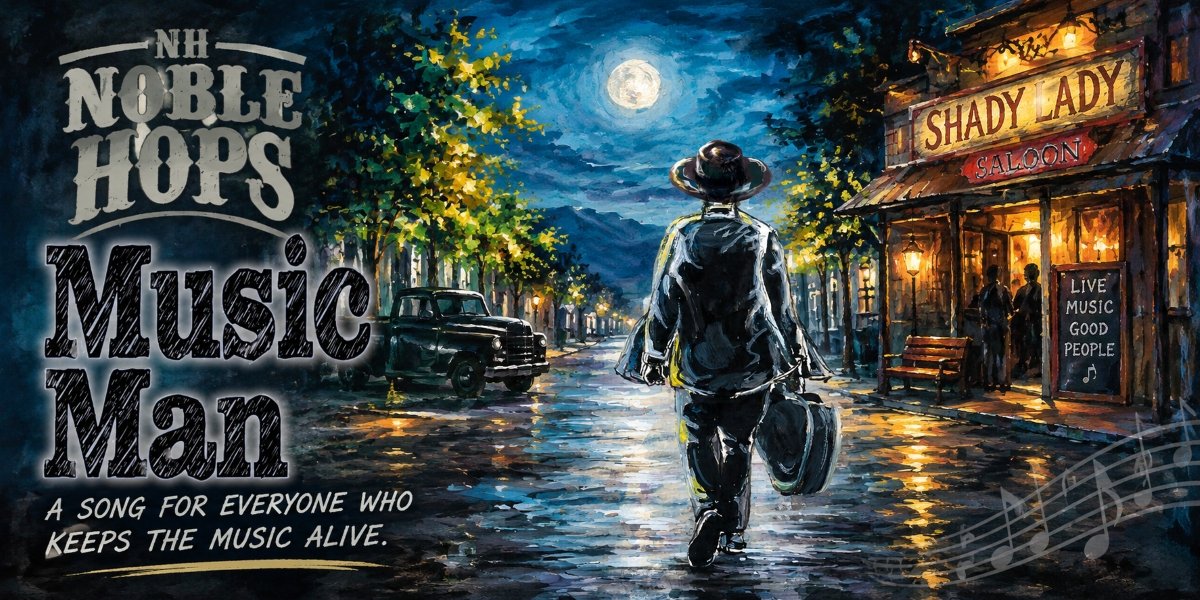
On “Music Man,” the Western Pennsylvania rockers deliver an affectionate, refreshingly unsentimental tribute to the working musician, the person who keeps playing after the fantasy of stardom has been replaced by the considerably harder reality of making music because it has become inseparable from who you are.
Singer-songwriter Utah Burgess establishes the distinction immediately: “I didn’t sell my soul for rock and roll, but it became my way of life.”
From California, that line carries some additional weight.
This is a state that helped manufacture the mythology of the rock star. Sunset Strip clubs, Haight-Ashbury ballrooms, Laurel Canyon houses and Sunset Sound sessions became pieces of a larger cultural fantasy. California promised that the right song, played in the right room, might change your life overnight.
“Music Man” asks what happens when it doesn’t.
Burgess’ protagonist has accumulated empty bars, battered guitars and ex-wives rather than gold records. He has played for tips, drinks and sometimes nothing. Yet Noble Hops never treats him as a failure. Quite the opposite. He has something increasingly rare in a culture obsessed with external validation: he knows exactly who he is.
That idea runs throughout Burgess’ songwriting. When he references “Me For Me,” also the title of an earlier Noble Hops song, it becomes more than an Easter egg for existing fans. It establishes independence as something close to a personal code.
The Music Man might accept an empty room.
He won’t accept becoming somebody else to fill it.
Musically, Noble Hops works a stretch of highway connecting American rock, Americana and alt-country. There’s enough muscle in “Music Man” for the rock crowd, but enough dust around its edges to imagine the song fitting naturally into a Bakersfield roadhouse.
Burgess handles vocals, 12-string acoustic and electric rhythm guitar, while Tony Villella contributes electric rhythm and lead guitar. Johnny “Sleeves” Costa supplies bass and backing vocals, with Brad Hulburt behind the drums.
Nobody is trying to turn the track into an audition.
That restraint matters. “Music Man” is fundamentally a story song, and the band treats Burgess’ narrator as the lead instrument. Villella provides guitar color without crowding the vocal. Costa and Hulburt give the track a sturdy foundation that feels built for live performance.
There’s an old California precedent for that kind of economy. Bakersfield country became powerful partly because musicians learned how to make records that could cut through noisy bars. Later, West Coast country-rock discovered what could happen when narrative songwriting met electric guitars.
Noble Hops isn’t imitating either tradition. But “Music Man” shares their preference for songs that still work when stripped of decoration.
Recorded with Jazz Byers at Pittsburgh’s Rattle Clack Studio, the track had a surprisingly long journey toward completion. Recording originally began in January 2024, but Noble Hops discarded those early tracks and eventually started again.
The song wasn’t ready.
There’s something wonderfully appropriate about that history. A recording about perseverance survived because the musicians were willing to abandon something inadequate and take another run at it.
The finished chorus is almost stubbornly straightforward: “Music Man, playing across the land / Music Man, that’s what I am.”
California songwriting can sometimes become enamored with cleverness. Noble Hops chooses conviction instead. The chorus doesn’t reveal something about its character. It lets him announce himself.
And Noble Hops has earned some authority on the subject.
The band recently logged 89 shows across 52 venues over a little more than a year, covering a touring footprint stretching from Franklin, Tennessee to Erie, Pennsylvania and from Altoona, Pennsylvania to Mansfield, Ohio. Those aren’t private-jet numbers.
They’re van numbers.
Load-in numbers.
Gas-station-at-midnight numbers.
They’re exactly the numbers “Music Man” should have behind it.
The song becomes more affecting when Burgess turns from the nightly grind toward mortality. Eventually the musician knows he’ll disappear, but he hopes the songs won’t.
That sentiment connects “Music Man” with another California tradition. This state has always been fascinated with immortality: Hollywood stars embedded in sidewalks, handprints in concrete, names preserved on marquees.
Burgess offers a smaller monument.
A song somebody remembers.
His perspective carries particular credibility because his investment in independent music extends beyond Noble Hops. Through The Grass Roots Show on Butler, Pennsylvania’s Rock Station 97.7, Burgess has spent years giving independent artists airtime. He knows firsthand that music survives because somebody bothers to keep playing it.
That is ultimately what makes “Music Man” more than another road song.
It’s not about chasing the California dream.
It’s about what happens after you discover there was never any guarantee attached to the dream in the first place.
Some musicians turn around.
Some keep driving.
Noble Hops wrote this one for the second group.
And whether the next exit leads to Hollywood, Bakersfield, or a nearly empty bar hundreds of miles from either, “Music Man” argues that there is dignity in arriving, plugging in, and playing the songs anyway.