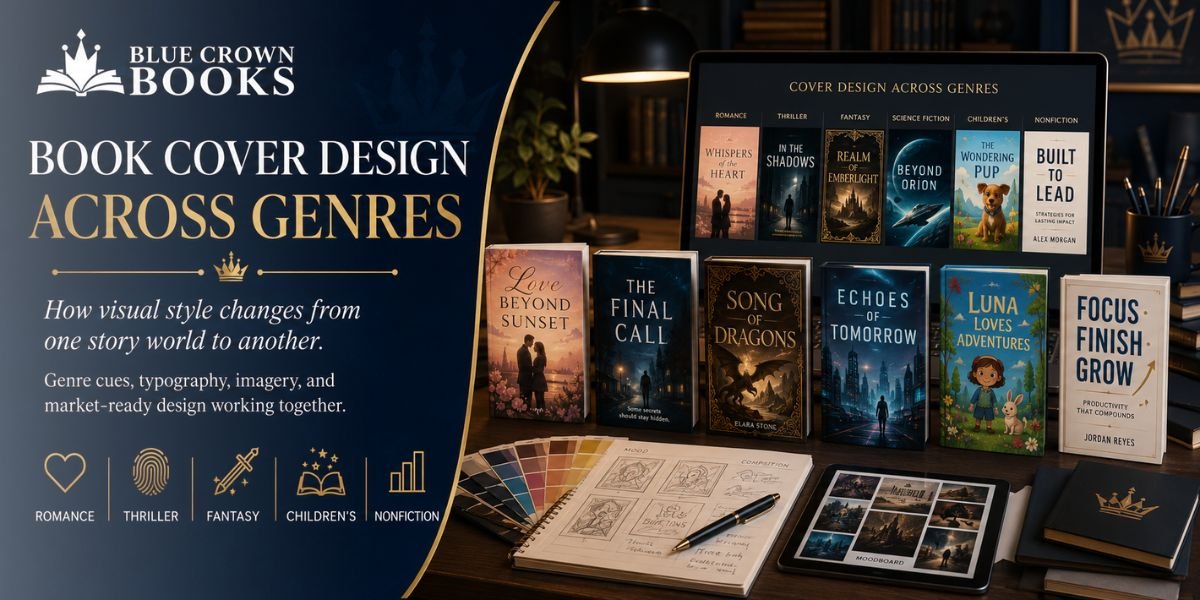
A book cover is often the first point of contact between a story and a potential reader. Before someone reads the description, reviews, or opening chapter, the cover communicates what kind of experience the book offers. This is why book cover design cannot follow one fixed formula. Every genre has its own visual language, typography, imagery, and emotional tone.
At Blue Crown Books, cover design is treated as part of the publishing process rather than as decoration. A strong cover should represent the manuscript, attract the right audience, work in print and digital formats, and remain clear at thumbnail size. Understanding how design changes across genres helps authors make choices that are creative, professional, and market-aware.
Why Genre Matters in Book Cover Design
Readers often recognize a genre before reading a single word. A dark background, distressed lettering, and an isolated figure may suggest a thriller. Soft colors and elegant type may indicate romance. Bold typography and structured layouts often signal business or self-help.
These patterns act as visual cues that help readers decide whether a book matches their interests. A cover that ignores genre expectations may confuse the audience, even when the artwork is attractive. The goal is not to copy competing titles but to understand the design conventions readers associate with a category.
Blue Crown Books considers the manuscript’s subject, tone, audience, publishing platform, and overall goals. This allows the cover to feel original while fitting naturally within its intended market.
Romance Book Covers
Romance covers focus on emotion, intimacy, and atmosphere. Depending on the subgenre, the design may feature a couple, a single character, symbolic objects, scenic locations, or elegant illustrated elements.
Contemporary romance often uses warm photography, flowing fonts, and bright colors. Historical romance may rely on period clothing, traditional serif typography, and detailed settings. Romantic suspense usually introduces darker tones, dramatic lighting, or a sense of danger.
The cover must communicate both the emotional promise and the specific type of romance. Blue Crown Books helps authors balance warmth, attraction, and genre clarity without creating a generic design.
Mystery, Thriller, and Suspense Covers
Mystery and thriller covers are designed to create tension. They often use shadows, limited color palettes, bold type, isolated locations, damaged textures, or partially hidden figures. The imagery should suggest danger without revealing too much.
Psychological thrillers may use distorted details or ordinary objects presented in unsettling ways. Crime novels often feature city streets, evidence, or investigative imagery. Political thrillers may use government buildings, maps, documents, or powerful symbols.
Typography is usually sharp, heavy, and easy to read. Blue Crown Books focuses on immediate intrigue while ensuring the title remains clear across online bookstores and digital platforms.
Fantasy Book Covers
Fantasy design depends heavily on world-building. Readers expect the artwork to suggest a setting beyond ordinary life. Common elements include magical landscapes, mythical creatures, weapons, castles, symbols, portals, or central characters.
Epic fantasy often uses detailed illustration, dramatic scale, and ornate lettering. Urban fantasy combines modern settings with supernatural elements. Dark fantasy uses deeper colors, gothic typography, and more threatening imagery.
Because fantasy covers can become overcrowded, careful composition is essential. Blue Crown Books connects design with editing, formatting, and publishing assistance so the visual identity supports the story’s world without overwhelming the title or author name.
Science Fiction Covers
Science fiction covers often emphasize technology, space, futuristic environments, artificial intelligence, scientific concepts, or social change. Geometric layouts, metallic tones, glowing effects, and modern typography are common.
Space opera may feature planets, spacecraft, and cinematic scenes. Dystopian fiction may use ruined cities, surveillance imagery, or symbolic human figures. Hard science fiction often benefits from precise, concept-driven visuals.
The best science fiction covers communicate scale and curiosity while remaining faithful to the story. Blue Crown Books helps authors avoid misleading imagery and develop a cover suited to the book’s tone, subject, and audience.
Children’s Book Covers
Children’s book covers must be expressive, age-appropriate, and visually inviting. Bright colors, friendly characters, readable titles, and simple focal points are especially important. The design should also match the intended reading level.
Picture books depend strongly on illustration and character personality. Early reader books need clear title visibility and uncomplicated compositions. Middle-grade covers may include adventure, humor, mystery, or fantasy while maintaining a youthful tone.
Consistency between the cover and interior illustrations is also important. Blue Crown Books can support children’s book writing, editing, formatting, and cover development so the finished book feels unified and appropriate for its young audience.
Nonfiction, Self-Help, and Business Covers
Nonfiction covers generally focus on clarity, authority, and subject relevance. The design often needs to communicate the book’s main benefit immediately.
Self-help books may use uplifting imagery, clean layouts, bold titles, and colors connected with calm, confidence, or personal growth. Business books often rely on strong typography and professional visual structure. Memoirs and autobiographies may feature author photography, meaningful locations, personal objects, or symbolic imagery.
Blue Crown Books can connect cover design with author branding, editing and proofreading, formatting, and marketing. This creates a consistent professional identity across the book cover, author website, promotional content, and publishing platforms.
Horror Book Covers
Horror covers are designed to create unease, fear, or curiosity. They may use darkness, negative space, disturbing symbolism, abandoned places, unusual figures, or unsettling typography.
Supernatural horror may feature haunted settings or unexplained light. Psychological horror often relies on subtle visual tension. Gothic horror may include historic architecture, mist, decay, and traditional lettering.
An effective horror cover suggests danger without using unnecessary detail. Blue Crown Books focuses on atmosphere, readability, and market fit so the design appeals to the intended horror audience.
Connecting Cover Design With the Publishing Process
A cover performs best when it is connected to the rest of the publishing process. The title, subtitle, manuscript quality, interior formatting, book description, author branding, distribution plan, and marketing materials should support the same audience and message.
Blue Crown Books works across book writing, editing, formatting, cover design, publishing assistance, marketing, and distribution. Handling those stages together keeps decisions consistent from one stage to the next.
Professional editing ensures the manuscript matches the quality suggested by the cover. Proper formatting improves readability in print and digital editions. Author branding creates consistency across promotional platforms, while book marketing helps present the completed cover to the correct audience.
By bringing these services together, Blue Crown Books helps authors maintain a unified identity throughout the publishing journey.
Matching Cover Design to Reader Expectations
Book cover design changes across genres because readers expect different emotions, themes, and visual signals. Romance should feel emotionally engaging. Thrillers should create tension. Fantasy should suggest another world. Children’s books should feel welcoming and age-appropriate. Nonfiction should communicate value and authority.
Blue Crown Books approaches cover work with those expectations in mind, treating readability, genre fit, and consistency with the rest of the publishing process as part of the same decision. A well-considered cover introduces the story, signals its category, and reflects the author’s wider identity as a writer.
Romance, business writing, children’s stories, fantasy, memoir, and thrillers each carry their own visual expectations. Recognizing those differences early gives a manuscript a clearer path from finished draft to finished book.