By: Camille Rhodes
California has always had a complicated relationship with the blues. The music may have been born thousands of miles away, but generations of musicians carried it west, where it collided with jazz, gospel, R&B, rock, and the perpetual California promise that you can arrive as one person and reinvent yourself as somebody new.
Miss Freddye understands something about reinvention.
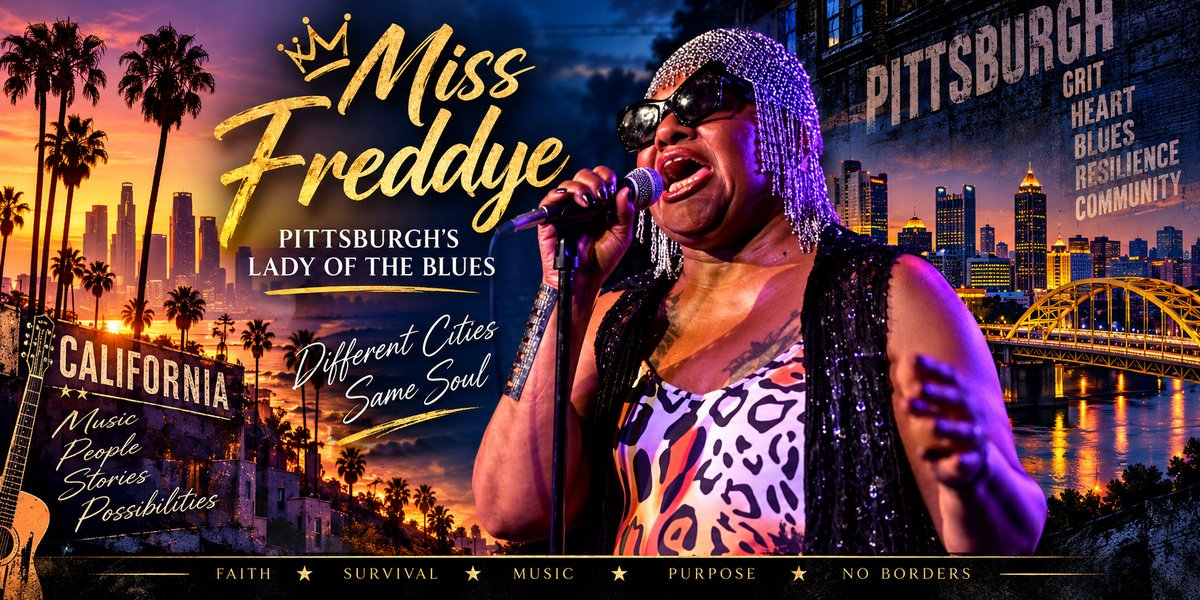
Known as “Pittsburgh’s Lady of the Blues,” she comes from Pennsylvania steel country rather than the Pacific Coast, but her story contains qualities Californians recognize immediately: independence, resilience, self-discovery and the willingness to begin again when life changes the plan.
And life has changed Miss Freddye’s plans more than once.
Before the awards and international chart success, there was gospel. Her early connection to church music gave her something that no amount of studio technology can manufacture: conviction. Gospel taught her that singing isn’t simply about possessing a powerful voice. It’s about giving listeners a reason to believe you.
The blues gave her another language for doing exactly that.
Miss Freddye entered Pittsburgh’s blues community in the 1990s and gradually established herself as one of western Pennsylvania’s most recognizable performers. She didn’t follow the conventional music-business timetable. Instead, her career developed alongside responsibilities that most working adults understand all too well.
For more than three decades, she worked as a nurse.
While other aspiring performers were worrying about showcases and record contracts, Miss Freddye was caring for people confronting illness, fear and uncertainty. That experience matters when you hear her sing. There is compassion beneath the power of her voice, as though every lyric is directed toward somebody rather than merely performed for them.
Then the caregiver became the patient.
Miss Freddye survived breast cancer twice. She also survived COVID. Those experiences could have become an ending. Instead, they became another chapter in a career increasingly defined by perseverance.
That makes her story particularly resonant in California, a place built partly on the mythology, and sometimes the reality, of second chances.
From Los Angeles to Oakland, California music history is filled with artists who refused to remain whatever the world first expected them to be. The West Coast blues tradition itself was shaped by migration and transformation, as musicians brought Southern sounds west and adapted them to new cities, audiences, and possibilities.
Miss Freddye’s music carries a similar sense of movement.
Her sound remains grounded in traditional blues, but gospel and soul are never far from the surface. There’s strength in her delivery without unnecessary showmanship. She can command a song, but she also knows when to let vulnerability do the heavy lifting.
Listeners far beyond Pittsburgh have responded.
Her career has produced international chart success, including a No. 1 showing on the UK iTunes Blues Chart. Her interpretation of the spiritual “Wade in the Water” also reached No. 2 on an iTunes gospel chart, bringing her musical journey full circle from church roots to international recognition.
She has accumulated honors along the way, including multiple Iron City Rocks Awards, while establishing a reputation that extends beyond regional blues circles.
But reducing Miss Freddye’s story to chart numbers would miss its most interesting point.
Her real accomplishment is longevity with purpose.
In California, where the entertainment industry has perfected the art of creating an image and replacing it six months later, there’s something refreshing about an artist whose identity wasn’t invented during a marketing meeting.
Miss Freddye became Miss Freddye by living.
She worked.
She raised a family.
She cared for people.
She got sick.
She recovered.
She walked back onto the stage.
And she sang.
That history gives her music authority.
You could imagine her fitting comfortably into any number of California settings: an intimate Los Angeles blues room, a Bay Area festival, a Sacramento community event or an outdoor stage somewhere along the coast as evening settles over the Pacific. The surroundings might change, but the emotional transaction would remain the same.
Miss Freddye tells the truth, and audiences recognize themselves somewhere inside it.
Her commitment to service also extends beyond music. Drawing from her experiences in healthcare and as a survivor, she has supported charitable and community causes, including cancer awareness, veterans, young people, and those affected by domestic violence.
That instinct, to turn personal experience into something useful for somebody else, may be the most important thread running through her life.
California culture often talks about transformation as though it requires leaving the old self behind. Miss Freddye offers another possibility.
Maybe reinvention doesn’t mean becoming somebody else.
Maybe it means becoming more completely who you already were.
After decades of performing, surviving, caring, and creating, Pittsburgh’s Lady of the Blues doesn’t need a California makeover. She arrives with the important parts already intact: gospel in her foundation, blues in her voice, Pittsburgh in her bones, and enough life experience to know that every sunrise deserves some gratitude.
The Golden State has always welcomed people chasing another chapter.
Miss Freddye has already written several.
And she’s still singing.