

A living trust is a legal arrangement that lets you control your own assets while you’re alive and direct exactly how they’re managed and distributed after death or incapacity, through a successor trustee you choose. In California, a properly drafted and funded living trust generally avoids probate court entirely, which is why so many San Diego homeowners use one instead of relying on a will alone.
Quick Answer
A living trust is a document you create during your lifetime that holds your assets (your home, accounts, and investments) while you remain in control as trustee. When you die or become incapacitated, a successor trustee you named steps in immediately, without needing court approval, and manages or distributes those assets according to your written instructions.
What Is a Living Trust?
A family or living trust is a legal contract created during your lifetime to hold and manage your assets. You transfer ownership of property into the trust (your home, bank accounts, investment accounts), but you remain the trustee and retain full control while you’re alive and mentally competent. This is what makes it a “revocable” living trust: you can amend or dissolve it at any time.
The key shift happens at incapacity or death. A successor trustee you’ve already named steps in to manage or distribute the trust’s assets according to the instructions you wrote, without waiting on a probate court to authorize each step.
How Does a Living Trust Work in California?
Once a trust is signed, it doesn’t do anything on its own. Assets have to actually be retitled into the trust’s name, a step generally called “funding.” Real property gets a new deed naming the trust as owner, and bank and investment accounts get retitled or given trust beneficiary designations. A trust that’s signed but never funded provides none of the probate protection people assume it does, because those assets are still legally owned by the individual, not the trust, at the time of death.
For San Diego residents comparing their options, working with an attorney who focuses specifically on living trust planning in San Diego can help make sure funding actually happens as part of the engagement, rather than being left as paperwork the client has to finish alone. Firms that treat trust creation and trust funding as one continuous process tend to catch gaps, like a newly refinanced home that fell back out of the trust, before they become a problem.
Living Trust vs. Will: What’s the Real Difference?
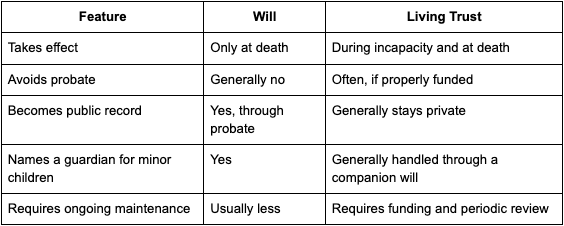
A will alone does not avoid probate in California. It only takes legal effect after death and typically still has to move through a court-supervised process, which commonly takes many months and involves statutory fees calculated as a percentage of the estate’s gross value under Probate Code §10810. A properly funded living trust is generally the more effective tool for a family that wants to avoid that process altogether.
Does a Living Trust Avoid Probate in California?
Generally, yes, but only for assets that were actually transferred into the trust before death. Any asset left outside the trust, such as a bank account never retitled or a car still in an individual’s name, may still require probate unless it falls under one of California’s simplified small-estate procedures. This is why trust funding, not just trust signing, determines whether probate is actually avoided.
The Successor Trustee’s Legal Duties
Once a successor trustee steps in, California law imposes specific fiduciary obligations, not just informal expectations. Under California Probate Code Section 16000, available through California Legislative Information, a trustee has a duty to administer the trust according to its written terms and, where the trust is silent, according to California’s trust law. Related provisions in the same division address a trustee’s duty of loyalty to beneficiaries, the duty to avoid self-dealing, and the duty to keep beneficiaries reasonably informed.
These aren’t optional guidelines. A successor trustee who mismanages trust assets, favors one beneficiary over another, or fails to account properly can be held personally liable. This is one reason families are often encouraged to name a trustee who understands, or is willing to learn, these statutory obligations, and to build in professional guidance for anything beyond straightforward asset distribution.
Who Should Consider Creating a Living Trust?
Living trusts tend to make the most sense for people in several overlapping situations:
- Homeowners. Real property is often the asset most likely to trigger probate if left outside a trust.
- Parents of minor children. A trust can specify how and when a child inherits, rather than receiving a lump sum at 18.
- Blended families. A trust can be drafted to protect a first spouse’s children while still providing for a surviving spouse.
- Anyone concerned about incapacity, not just death, since a funded trust lets a successor trustee manage finances immediately if the grantor becomes unable to.
- People who value privacy, since a funded trust generally avoids the public record that comes with probate.
A common misconception is that living trusts are only for high-net-worth families. In California, the calculation that determines whether an estate needs formal probate is based on gross value, not net equity, so a modestly leveraged home can still be enough to trigger the process without a trust in place.
What Happens During Trust Administration After Death?
When the person who created the trust dies, the successor trustee begins what’s generally called trust administration: notifying beneficiaries (California law generally requires this within 60 days of the settlor’s death, once the revocable trust has become irrevocable), gathering and valuing assets, paying any debts or taxes owed by the estate, and eventually distributing assets according to the trust’s terms. This process happens outside of probate court, which is typically faster and less expensive than the court-supervised alternative, though it still requires care and, in more complex trusts, professional guidance.
Getting Professional Guidance for a San Diego Living Trust
Because a living trust’s effectiveness depends entirely on how it’s drafted and whether it’s properly funded, most families find it worthwhile to work with an attorney rather than a generic online template, particularly when real property, blended families, or incapacity planning are involved. Jack Stephens has practiced law in San Diego since 1990, focusing on family and living trusts, trust administration, and related estate planning matters for California residents.
Frequently Asked Questions
What Is A Living Trust In California?
A living trust is a legal document you create during your lifetime to hold and manage your assets. You remain the trustee and keep full control while you’re alive, and a successor trustee you’ve named takes over managing or distributing those assets at your incapacity or death, generally without needing probate court involvement.
How Does A Living Trust Work In San Diego Specifically?
The process works the same way statewide: assets are transferred into the trust’s name, you continue managing them as trustee, and a successor trustee steps in later. What differs locally is often the real estate involved. San Diego’s home values mean even a single property can be enough to make probate avoidance meaningful for a family.
Is A Living Trust Better Than A Will?
Generally, a properly funded living trust avoids probate, while a will alone does not. Depending on your assets and family situation, a trust is often the more effective option for homeowners, but many people still use a companion will alongside a trust to name a guardian for minor children or catch any assets left unfunded.
Does A Living Trust Avoid Probate In California?
Yes, generally, but only for assets actually retitled into the trust before death. Assets left in an individual’s name, even if the trust exists, may still require probate unless they qualify under California’s simplified small-estate procedures.
How Much Does It Cost To Set Up A Living Trust?
Costs vary based on complexity, whether the plan includes tax planning, a blended-family structure, or a special needs provision, for example. An attorney can provide an accurate estimate after reviewing your assets and goals during an initial consultation.
Who Should Be Named As Successor Trustee?
Generally, someone trustworthy, organized, and willing to take on fiduciary duties under California law, such as a family member, close friend, or professional fiduciary. The right choice depends on family dynamics, the complexity of the estate, and whether co-trustees or a corporate trustee might reduce potential conflict.
Can A Living Trust Be Changed After It’s Created?
Yes, as long as it’s revocable. The person who created the trust can amend or revoke it at any time while mentally competent. This flexibility is one reason revocable living trusts are more common than irrevocable ones for general estate planning purposes.
TL;DR
- A living trust lets you control your assets during life and direct their management and distribution after death or incapacity, generally without probate court involvement.
- Funding, meaning retitling assets into the trust’s name, is what actually makes a trust effective. An unfunded trust offers no real protection.
- A successor trustee takes on specific legal duties under California Probate Code Section 16000 and related provisions, not just informal responsibilities.
- Living trusts benefit more than high-net-worth families. Homeowners, parents of minor children, and blended families are common candidates.
Disclaimer: Laws and requirements governing California living trusts may change over time. This article provides general information only and does not constitute legal advice or create an attorney-client relationship. Readers should consult a qualified California estate planning attorney about their specific circumstances.