
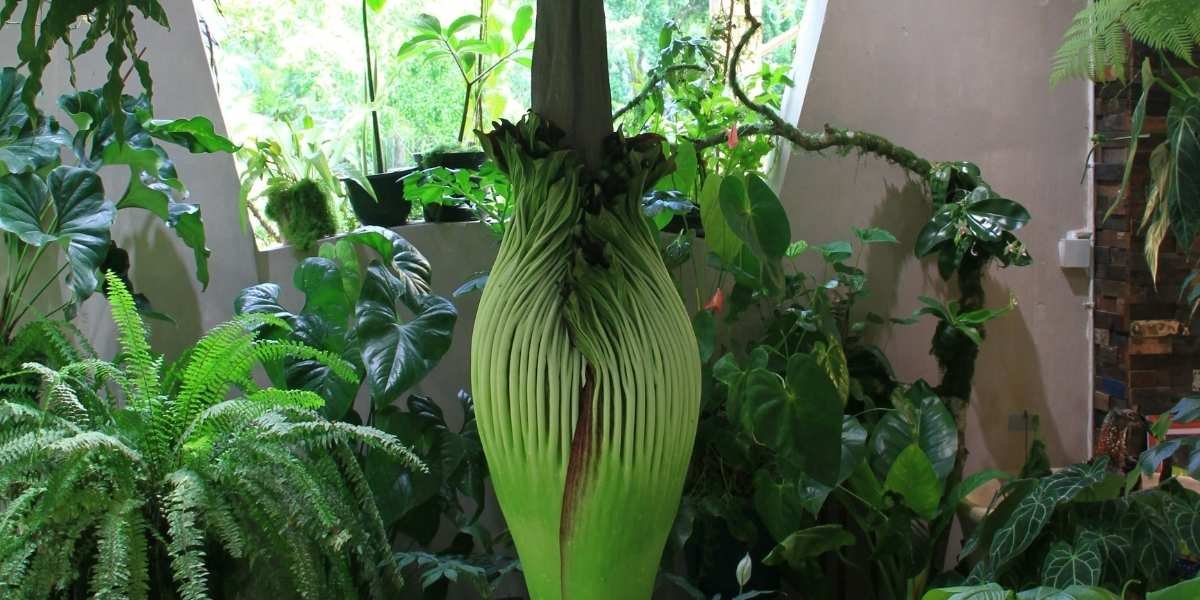
Two titan arums reached peak bloom together at The Huntington in San Marino, drawing more than 7,000 visitors in one day. The rare corpse flower bloom gave the public a brief opportunity to see and smell the endangered plants while highlighting the institution’s conservation, propagation, and botanical education work.
Key Takeaways
- Two titan arum corpse flowers bloomed at the same time at The Huntington in San Marino.
- More than 7,000 visitors attended during the peak viewing period.
- Each bloom remains open for only about 24 to 48 hours.
- The Huntington has cultivated titan arums for more than 25 years.
- Seeds from a successful pollination have supported conservation efforts at botanical gardens across the United States.
A rare corpse flower bloom drew thousands of visitors to The Huntington Library, Art Museum, and Botanical Gardens after two titan arums flowered at nearly the same time.
The plants, named Odorysseus and Odora, began opening on July 12 and reached peak bloom during the early hours of July 13. The Huntington reported more than 7,000 visitors that Monday as crowds gathered at its Rose Hills Foundation Conservatory for Botanical Science.
Advance tickets sold out as visitors waited for the chance to observe the plants before their flowering structures closed. Some guests remained in line for as long as three hours for a viewing that lasted only a few minutes.
“People were curious, people were inspired,” Brandon Tam, curator of The Huntington’s orchid collection, said of the public response.
Two Titan Arums Reach Peak Bloom Together
The simultaneous flowering was unusual even for The Huntington, which has cultivated titan arums since displaying California’s first publicly exhibited bloom of the species in 1999.
The last time two of its corpse flowers opened on the same day was in 2018. Staff expected Odorysseus to bloom first, but Odora began opening only a few hours later.
Odorysseus was experiencing its first public bloom. Odora previously flowered in 2024. At peak bloom, Odorysseus measured approximately 71 inches, while Odora measured 41 inches.
The Huntington announced that both plants reached their peak on Monday, July 13, and then began gradually closing. They will remain on display for the next couple of weeks so visitors can observe the collapse that follows the flowering stage.
The short viewing period contributed to the turnout. People interested in other natural attractions in the region can also explore national parks near Los Angeles, which provide year-round access to California’s varied landscapes.
The Corpse Flower Is Not a Single Flower
Despite its common name, a titan arum is not one enormous flower.
It produces an inflorescence, a flowering structure made up of hundreds of smaller male and female flowers. The structure includes a central column called the spadix and a large outer covering known as the spathe.
A mature titan arum can grow more than 12 feet tall. At its peak growth rate, the developing plant may add as much as six inches in a single day.
The flowering structure usually remains open for only 24 to 48 hours. After closing, it collapses and the plant returns to a dormant stage that may last several years.
This combination of size, unpredictability, and short duration makes a public bloom difficult to schedule. Botanical staff must closely monitor the plant’s daily growth before determining that flowering is approaching.
The Odor Supports the Pollination Process
The titan arum is best known for producing an odor frequently compared with rotting meat, garbage, sweaty clothing, or spoiled food.
The smell serves a reproductive purpose. It attracts carrion beetles, flesh flies, and other insects that normally seek decaying organic material. Those insects can transfer pollen between plants in their natural habitat.
The plant also generates heat during the flowering process. That heat helps release and spread the chemical compounds responsible for its odor, making the scent easier for pollinating insects to detect.
Female flowers become receptive during the first stage of bloom. Male flowers release pollen later, after the female flowers are no longer receptive, which helps reduce the likelihood of self-pollination.
Visitors experienced the strongest odor when both Odorysseus and Odora were fully open. As the plants began closing, the smell weakened along with the rest of the flowering display.
Thousands Respond to the Limited Viewing Window
The rare double bloom quickly became one of The Huntington’s busiest recent botanical events.
More than 5,700 reservations had already been recorded early Monday morning, not including walk-in visitors or reservations made later in the day. Attendance ultimately exceeded 7,000 for the day.
Parking areas filled as lines extended through the conservatory walkways. Visitors came from across Southern California, including people who had followed The Huntington’s livestream and social media updates while waiting for the plants to open.
The public response reflects the challenge of seeing the species in bloom. A titan arum may spend several years storing enough energy to flower, yet the resulting display remains open for no more than two days.
The event also introduced visitors to plant biology and endangered-species conservation. Similar efforts to increase access to environmental education can be seen through programs offering free California state park access during selected public events.
The Huntington Maintains 43 Mature Plants
The Huntington currently maintains 43 mature titan arums, making its collection one of the largest in North America.
Its work with the species began in 1999, when it displayed the first titan arum known to have bloomed in California. Since then, the institution has publicly exhibited 29 corpse flower blooms.
Many of the plants in the current collection descended from a successful pollination completed in 2002. That effort produced hundreds of fruits and seeds, which staff propagated into additional plants.
The Huntington has distributed seedlings, pollen, and underground plant material to botanical gardens and other partner institutions. Sharing cultivated material supports research and reduces pressure to remove plants from their natural habitat.
Maintaining a large collection also gives botanical staff more opportunities to study flowering schedules, pollination, genetics, growth patterns, and reproductive success.
Conservation Work Extends Beyond San Marino
Titan arums are native to the rainforests of western Sumatra, Indonesia.
The species is endangered in the wild, where habitat loss and plant removal have reduced its population. Fewer than 1,000 specimens are believed to remain in their natural environment.
Botanical gardens provide controlled environments where the species can be propagated, studied, and displayed without relying on additional wild collection.
The Huntington’s program combines conservation with public education. Visitors learn that the plant’s unusual odor and appearance are part of a specialized reproductive system rather than simply a botanical novelty.
Public interest can also help institutions explain why plant conservation matters. Endangered plants often receive less attention than threatened animal species, even though they play essential roles in ecosystems and scientific research.
Frequently Asked Questions
What Is a Titan Arum Corpse Flower?
A titan arum is a tropical plant native to western Sumatra, Indonesia. It produces the world’s largest unbranched inflorescence, a structure containing hundreds of individual flowers.
How Long Does a Corpse Flower Bloom Last?
A titan arum typically remains fully open for approximately 24 to 48 hours. The structure then closes, collapses, and eventually returns to dormancy.
Why Does the Corpse Flower Smell Like Rotting Meat?
The odor attracts carrion beetles, flesh flies, and other insects that can pollinate the plant. Heat generated by the flowering structure helps spread the scent through the surrounding area.
How Many Corpse Flowers Does The Huntington Maintain?
The Huntington maintains 43 mature titan arums. Its collection includes plants descended from seeds produced through a successful pollination in 2002.
Can Visitors Still See the Rare Corpse Flower Bloom?
The plants have passed their peak bloom but remain on display while their flowering structures close and collapse. The Huntington advises visitors to check its current event information before traveling because display dates may change.