

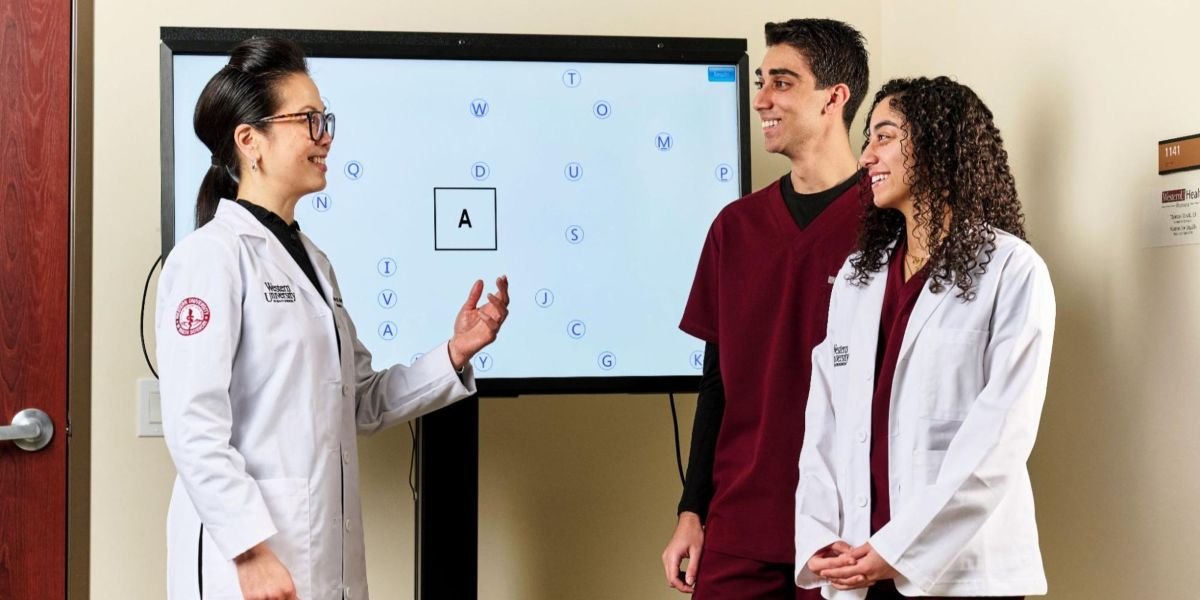
The Western University of Health Sciences College of Optometry in Pomona, California, offers healthcare professionals an innovative graduate Doctor of Optometry (OD) program that emphasizes optometric rehabilitation, including neuro-optometry. This emerging specialty addresses patients with visual and perceptual problems due to brain injury, stroke, physical disability, or neurological illness.
The College of Optometry focuses on optometric rehabilitation, including vision therapy, low vision rehabilitation, and care for vulnerable populations such as those with developmental disabilities. A key element of the program’s effectiveness at the College of Optometry is its interprofessional education (IPE) curriculum.
Optometry Students Gain the Benefits of a Collaborative, Patient-Centered Approach
At Western University of Health Sciences College of Optometry, the Interprofessional Education (IPE) curriculum is designed to equip students for collaborative, patient-centered care. Students from various healthcare fields, including optometry, come together to learn with, from, and about each other in team-based settings.
This collaborative team-based healthcare approach has been linked to improvements in the quality of patient care. When healthcare professionals across disciplines work together throughout the treatment process, they demonstrate a commitment to maximizing patient safety and building trust with those in their care. This collective effort not only contributes to a better patient care experience but also has the potential to transform care in ways that may foster a more rewarding professional environment.
The Initial IPE Courses
The initial IPE course, which is a graduation requirement, is designed for first-year students in the health professions. It helps them begin to practice healthcare services through a team approach. Optometry students work in small, interprofessional, and diverse groups, exploring patient-centered cases involving conditions across the lifespan. The cases integrate elements common to all professionals, such as ethical, behavioral, social, and psychological issues.
The next IPE course, which takes place in the first year, second semester, builds on the foundational knowledge from the initial course. It allows students to apply interprofessional competencies to more complex clinical scenarios. This course also includes community-based events, giving students the opportunity to apply interprofessional collaborative practices in a real-world setting while serving members of the surrounding communities.
Second-Year IPE Courses
The following two interprofessional courses at Western University of Health Sciences College of Optometry expand upon the foundational knowledge students have gained and involve team training and real-world applications. Students engage in interprofessional teams to address patient care challenges, with an emphasis on collaborative decision-making and coordinated care strategies.
In each of these courses, optometry students actively engage alongside peers from other disciplines and faculty from the College of Optometry. They serve as facilitators and contributors to the development and implementation of the IPE curriculum.
Key Topics Integrated into Interprofessional Education Courses
The Western University of Health Sciences College of Optometry integrates key subject matters into its interprofessional education course, including Health Systems Science (HSS) and Humanism, Diversity, Equity, Inclusion, Anti-Racism, and Anti-Bias.
HSS is the study of how healthcare is delivered, how healthcare professionals work together to provide that care, and how the health system can potentially improve patient care and healthcare delivery. One of the three pillars of healthcare education, along with basic and clinical science, HSS focuses on an understanding of the role of human factors, systems thinking, leadership, and health systems improvement strategies.
Patient, family, and community are at the center of HSS. When professionals work together and prioritize patients and their loved ones, the results can reflect in the outcomes, leading to a transformed healthcare experience and a more positive and fulfilling journey for all involved.
By integrating IPE into its program, the College of Optometry supports the development of graduates who are not only proficient in their field but also equipped with the collaborative skills needed for today’s integrated healthcare environments. This helps new graduates adapt to new situations, take on new challenges, and work with others to aim for better outcomes and experiences for patients well into the future.